You don’t need a lifetime of sea salt in your hair to feel at home on the water. While the maritime world often feels gated behind thick manuals and confusing jargon, the path to becoming a qualified small vessel operator can be a straightforward journey when you have the right guidance. Whether you’re dreaming of weekend fishing trips or looking to start a new career with a Coxswain Grade 3 ticket, the initial hurdle is often just knowing where to start and which regulations apply to your specific goals.
We understand that the difference between recreational and commercial requirements can be a bit of a headache, and the thought of a practical assessment might make you feel a little nervous. That’s why Master Boat Licence has put together this 2026 guide to give you total clarity on the licensing process. We’ll walk you through the essential safety obligations, the step-by-step training requirements, and how to gain the confidence you need to handle a boat with ease. By the end of this article, you’ll have a clear, stress-free roadmap to getting your licence and heading out onto the waterways with absolute peace of mind.
Key Takeaways
- Understand the legal requirements to become a qualified small vessel operator in NSW, including the key distinctions between recreational and commercial roles.
- Identify the essential study materials and the mandatory mix of theory and practical training needed to secure your maritime credentials.
- Compare the General Boat Licence with the Coxswain Grade 3 ticket to determine which pathway aligns with your boating or career ambitions.
- Follow a simplified, step-by-step roadmap to navigate the enrolment process and pass your maritime exam without the stress of confusing jargon.
- Discover how flexible online theory preparation and practical boating instruction can help you build confidence while working through the current NSW licensing pathway.
Defining the Small Vessel Operator Role in NSW
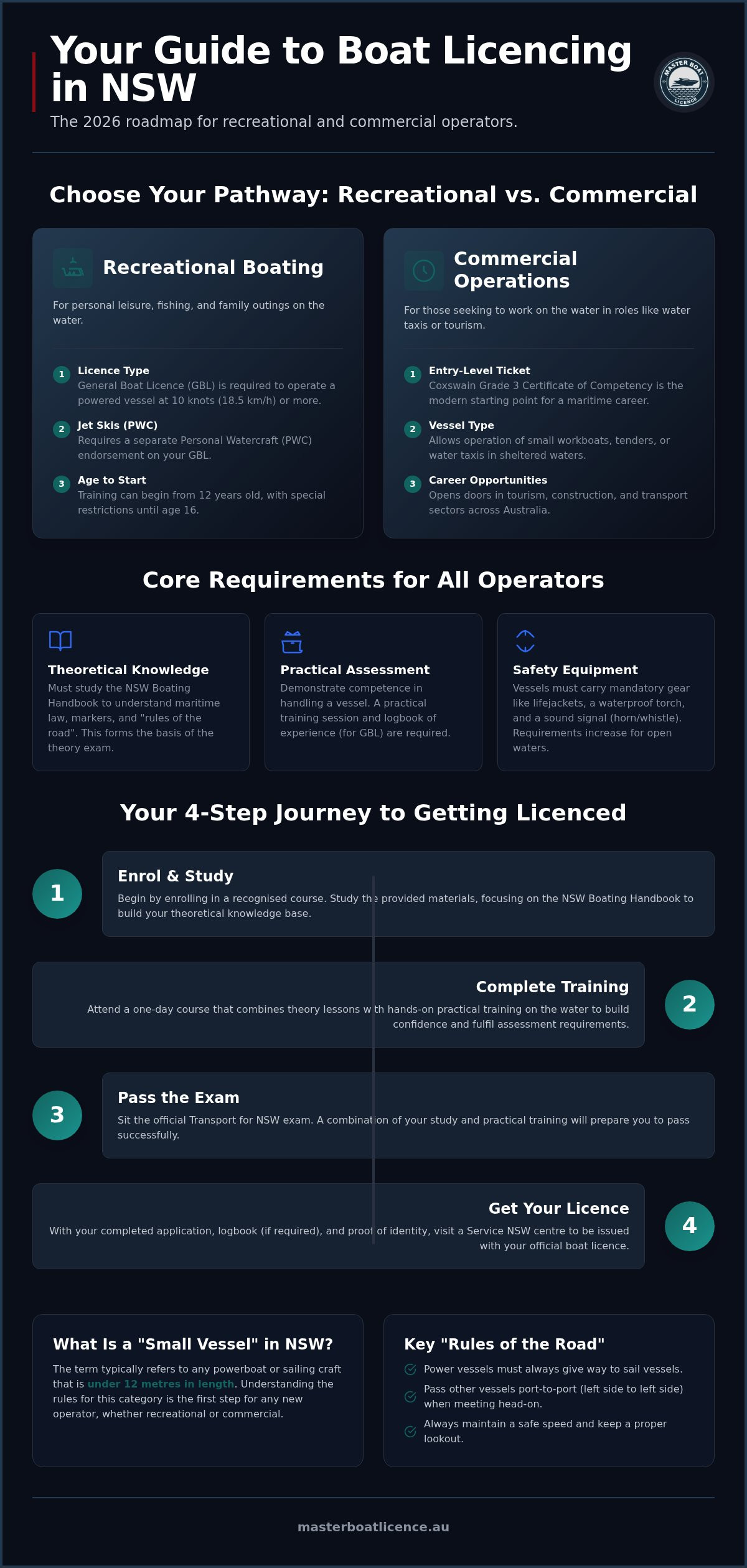
In NSW, the term “small vessel” typically refers to powerboats and sailing craft under 12 metres in length. Whether you are heading out for a morning of fishing or looking to start a career on the water, understanding your specific role is the first step toward success. Being a small vessel operator NSW means more than just steering a boat; it involves a deep understanding of maritime law, safety equipment, and the specific “rules of the road” that keep our waterways orderly. The distinction between a recreational driver and a commercial operator often boils down to the purpose of your trip. If you are out for leisure, you fall under recreational rules. If you are operating a vessel for work or reward, you have entered the professional maritime space.
The term “small vessel operator” is increasingly used in commercial maritime standards to align NSW regulations with national benchmarks. This shift ensures that even entry-level professionals have a consistent set of skills that are recognised across Australia. Formal training isn’t just a legal hoop to jump through. It’s a vital safety measure that prepares you for the unpredictable nature of the ocean. By learning from an expert guide like Greg, you bridge the gap between reading a manual and actually feeling confident when you’re behind the wheel in a busy channel.
Recreational Boating in NSW
For most people, the journey starts with a General Boat Licence. You need this qualification if you plan to operate any powered vessel at a speed of 10 knots (roughly 18.5 km/h) or more. If your interests involve more speed, you’ll need a Personal Watercraft (PWC) endorsement to legally operate a jet ski. In NSW, young enthusiasts can start their training from the age of 12. These junior operators are subject to specific restrictions, such as speed limits and the requirement to be supervised by a licensed adult, until they reach 16. Our study resources and practical instruction are designed to make these rules clear and easy to follow for boaters of all ages.
Commercial Maritime Operations
If you want to turn your passion into a profession, the Coxswain Grade 3 Certificate of Competency is the modern entry point. This commercial ticket allows you to operate small workboats, water taxis, or tender vessels in sheltered waters. It is a practical, accessible qualification that serves as a bridge for those transitioning from recreational boating into the maritime industry. Many find that the step up to a professional level is much easier than they expected, especially when the training focuses on real-world application rather than just dry theory. This certification opens doors to employment in tourism, construction, and transport sectors across the state.
Essential Requirements for Operating Small Vessels in NSW Waters
The primary resource for any aspiring small vessel operator NSW is the NSW Boating Handbook. It’s the essential guide for the theory exam, but reading it is only half the battle. To legally operate a boat, you need a combination of theoretical knowledge and a practical assessment. This ensures you don’t just know what a port marker looks like on paper, but can actually identify it while bouncing on the swell in the real world. Mastering the theory gives you the “why,” but the practical training provides the “how.”
Safety equipment isn’t optional; it’s a legal lifeline. Every vessel must carry specific gear based on its size and where it’s being used. At a minimum, you’ll need lifejackets that are the correct size for everyone on board, a waterproof torch, and a sound signal like a whistle or horn. If you’re heading into open waters, your requirements increase to include items like flares and a marine radio. Understanding these obligations is a core part of your responsibility as a skipper.
The “Rules of the Road” are what prevent collisions and keep our busy harbours safe. In NSW, the rules are clear: power gives way to sail, and you should always pass port-to-port when meeting another vessel head-on. You must also maintain a safe speed and keep a proper lookout at all times. If you’re feeling a bit overwhelmed by these regulations, attending a NSW boat licence course is a great way to turn that confusion into confidence under the guidance of an expert.
Licensing Prerequisites
Before you sit your exam, you need to provide Evidence of Identity (EOI) to Transport for NSW. This usually involves a combination of documents like a passport, birth certificate, or a current driver’s licence. For recreational applicants, completing a logbook is a vital step. This document records your time on the water under the supervision of an experienced skipper. If you’re aiming for a commercial qualification, you’ll also need to meet specific medical and eyesight standards to ensure you’re fit for professional maritime duties.
Safety and Environmental Responsibilities
Operating a boat comes with strict legal duties. Alcohol and drug limits on the water are just as serious as they are on the road; for most operators, the blood alcohol limit is 0.05. You also have environmental duties to protect our waterways. This means managing your noise levels and being mindful of your wash, which can damage riverbanks and disturb other vessels. Every skipper carries a “Duty of Care,” meaning you’re legally responsible for the safety of your passengers and for avoiding any actions that could harm other water users.
Recreational vs. Commercial: Which Pathway Suits Your Needs?
Deciding on the right qualification depends entirely on your long-term goals. For many, the pull of the water is about relaxation and spending quality time with mates. For others, it’s about a career change and the chance to work in one of the most beautiful offices in the world. As a small vessel operator NSW, you have two primary routes to choose from, each with its own set of rules and rewards. Understanding the investment of time and money required for each will help you make an informed choice that fits your lifestyle.
The choice often comes down to a simple question: do you want to get paid to be on the water? A recreational licence is perfect for leisure, but it strictly prohibits any “for hire or reward” work. If you have professional ambitions, the commercial pathway is an investment in your future. While the initial training for a commercial ticket is more involved, it unlocks a range of employment opportunities that a standard boat licence simply cannot match.
The Recreational Pathway
The recreational route is designed for those who want to enjoy boating for leisure, fishing, or family outings. The beauty of this path is its accessibility. You can study the theory online at your own pace, complete an accepted practical experience pathway, and then sit the official knowledge test through Service NSW. This model is ideal for absolute beginners because it condenses the learning into a supportive, hands-on environment. However, remember that this licence is for personal use only. You cannot charge people for trips or use your boat for commercial business activities.
The Commercial Pathway (Coxswain 3)
If you’re looking to enter the maritime industry, the Coxswain Grade 3 Certificate of Competency is your entry-level professional ticket. This qualification allows you to work as a small vessel operator NSW on commercial craft up to 12 metres in length. You’ll find opportunities in tourism, such as driving small charter boats, or in maritime services like operating workboats and barges. Unlike the recreational licence, this pathway is overseen by the Australian Maritime Safety Authority (AMSA). It requires a mix of formal training, specific sea time, and a final practical assessment to ensure you meet professional industry standards.
Step-by-Step Guide to Obtaining Your Maritime Qualifications
Getting your credentials to be a small vessel operator NSW is a logical, structured journey. It begins with choosing a training provider that specialises in beginner-friendly instruction. Instead of trying to piece together the requirements on your own, a recognised course brings all the necessary elements together in a single session. You’ll move from enrolment to your practical assessment with a clear sense of progress. Once you’ve successfully completed the training, the final step is simply lodging your paperwork at a Service NSW centre or through AMSA for commercial tickets.
A structured pathway is effective because it lets you study at your own pace and reinforce the theory during practical boating instruction. By combining classroom learning with immediate on-water application, the rules of the sea start to make sense in a real-world context. This streamlined approach removes the hassle and ensures you’re ready to handle a boat with confidence from day one.
Preparing for the Theory Test
Your foundation starts with the NSW Boating Handbook. Don’t just skim the pages; focus on the high-priority sections like navigation marks, lights, and right-of-way rules. Using practice tests is a brilliant way to build your confidence before the actual exam. Many beginners struggle by rushing through the multi-choice questions. Take your time to read every option carefully. Most mistakes happen when people misinterpret a question about give-way rules or safety equipment requirements. A little bit of steady preparation ensures you’ll pass the theory component without the stress.
Mastering the Practical Assessment
The on-water component is where you demonstrate that you can handle a vessel safely and competently. You’ll need to show your instructor that you can perform essential manoeuvres like coming alongside a wharf and handling the boat at various speeds. Safety drills are a major focus of this session, including:
- Executing a proper Man Overboard (MOB) recovery.
- Performing emergency anchoring procedures correctly.
- Conducting a thorough pre-departure safety check of all gear.
- Identifying and responding to different channel markers.
Learning these skills in a supportive, low-pressure environment makes a world of difference for your confidence. When you aren’t feeling judged, you can focus on the mechanics of steering and throttle control. If you’re ready to take the first step toward becoming a safe small vessel operator NSW, you can explore your NSW boat licence training options and begin with the pathway that suits you.
Master Your Skills with Professional Training at Master Boat Licence
Choosing where to train is the most important decision you’ll make after deciding to get on the water. At Master Boat Licence, we’ve refined our programme to ensure that becoming a small vessel operator NSW is an achievable goal for everyone. Instructor Greg brings years of experience to the table, acting as an expert guide who simplifies the complex world of maritime regulations. Our training is about connecting clear theory preparation with practical on-water skills. This holistic approach ensures that when you leave us, you don’t just have the paperwork, you have the actual skills to handle a vessel safely.
We’ve stripped away the bureaucratic headache to provide a streamlined, hassle-free experience. Our training caters to both recreational skippers and those looking for a professional start with a Coxswain Grade 3 Skipper’s Ticket. We believe that learning should be supportive and patient, not intimidating. By the time you finish your session, the maritime jargon that once felt like a foreign language will feel like second nature. We bridge the gap between being a novice and a confident mariner in a single, well-paced day.
A Beginner-Friendly Approach
You don’t need to have ever stepped foot on a boat to join our course. We specialise in teaching absolute beginners from the ground up, ensuring no one feels left behind or overwhelmed. Our commitment to thorough instruction means we take the time to answer every question, no matter how basic it might seem. We focus on building your confidence through clear, sequential steps that make sense. For a deeper look at what to expect, check out our How to Get a NSW Boat Licence in 2026 to help you prepare for your session.
Start Your Maritime Journey Today
Convenience is key when you’re ready to start your life on the water. We offer training at various locations across NSW to make it as easy as possible for you to find a session near home. Booking your spot is a straightforward process, and we’ll provide you with a clear list of what to bring, such as your Evidence of Identity and suitable clothing for the weather. Taking that first step is often the hardest part, but with our supportive team behind you, you’ll gain the confidence to take the wheel. Join us and discover how simple it is to gain your qualifications and start exploring our beautiful waterways with absolute peace of mind.
Start Your Adventure on the Water Today
Becoming a qualified small vessel operator NSW is more than just a legal requirement; it’s your ticket to a lifetime of safe boating. Whether you’ve chosen the recreational path for family weekends or a professional Coxswain 3 career, the journey is simple with the right support. We’ve seen how a single day of focused training replaces months of confusion. It bridges the gap between theory and real-world skill.
With over 20 years of maritime experience and a close affiliation with Marine Rescue, instructor Greg provides the patient guidance you need to succeed. Our training helps you prepare efficiently without cutting corners on safety. You will develop practical skills and greater confidence for operating on NSW waterways. View NSW boat licence theory and practical training options and take the first step toward your new life on the harbour. We can’t wait to see you out there.
Frequently Asked Questions
What is the difference between a general boat licence and a PWC licence in NSW?
A General Boat Licence allows you to operate any power-driven vessel at speeds of 10 knots or more. A PWC licence is a specific endorsement required to operate personal watercraft, such as jet skis, at any speed. You must hold a general licence before you can gain your PWC qualification. Many students choose to complete both during a single training session to save time and ensure they’re fully covered for all types of water activities.
Can I get my boat licence in a single day in NSW?
The current recreational boat licence pathway may involve separate stages. You can prepare for the theory online, complete an accepted practical experience pathway, then book the official knowledge test and lodge your application through Service NSW. Check the current Service NSW requirements before attending.
Do I need any prior experience to attend a small vessel operator course?
No prior experience is required to enrol in our courses. We specialise in teaching absolute beginners who have never even sat in a skipper’s seat before. Our expert instructors walk you through everything from basic safety gear to complex navigation rules in a patient and supportive environment. We believe that everyone should have the chance to enjoy the water, so we start with the fundamentals to build your confidence from scratch.
What vessels can I operate with a Coxswain Grade 3 ticket?
A Coxswain Grade 3 ticket allows you to operate commercial vessels up to 12 metres in length. This includes workboats, water taxis, and tender vessels in sheltered waters. It’s the perfect entry point for those looking to work as a professional small vessel operator NSW. While there are limits on the number of passengers you can carry, this qualification opens up numerous employment opportunities in the maritime industry, from tourism to harbour maintenance.
How much does a boat licence course cost in NSW for 2026?
Costs for boat licence courses in NSW can vary depending on the provider and the level of training you require. While we don’t list specific prices here as they can change, you should factor in the cost of the training course itself plus the separate licence fee paid directly to Transport for NSW. Compare the available theory and practical options, and remember that the official licence fee is paid separately to Service NSW.
Is the NSW boat licence valid in other Australian states?
Yes, a NSW boat licence is typically recognised in other Australian states and territories if you’re visiting for a short period. However, if you move interstate permanently, you’ll usually need to transfer your qualification to the local maritime authority within three months. Each state has slightly different regulations, so it’s a good idea to familiarise yourself with the local rules of the road whenever you’re boating in unfamiliar waters outside of NSW.
What happens if I fail the boat licence theory test?
If you don’t pass the theory test on your first attempt, don’t worry. Most training providers allow you to re-sit the exam after a bit more study. We focus on identifying the specific areas where you struggled, such as navigation lights or give-way rules, and provide extra guidance to help you understand the material. Our goal is to ensure you feel confident and knowledgeable, so we support you until you’re ready to pass with flying colours.
How do I renew my small vessel operator qualifications in NSW?
Renewing your recreational qualifications is a simple process handled through Service NSW. You can choose to renew for a period of one, three, five, or ten years, depending on your preference. For commercial qualifications like the Coxswain Grade 3, you’ll need to follow the renewal guidelines set by the Australian Maritime Safety Authority (AMSA). Keeping your details up to date ensures you’re always legal and ready to hit the water whenever the weather is right.